Earned Secure Attachment: How to Rewire Your Brain for Healthy Love
By Lena Ortiz
Behavioral Psychology & Relationship Expert
If you grew up with an anxious or avoidant attachment style, you are not doomed. Learn the clinical concept of 'Earned Security' and how to actively heal your dating patterns.
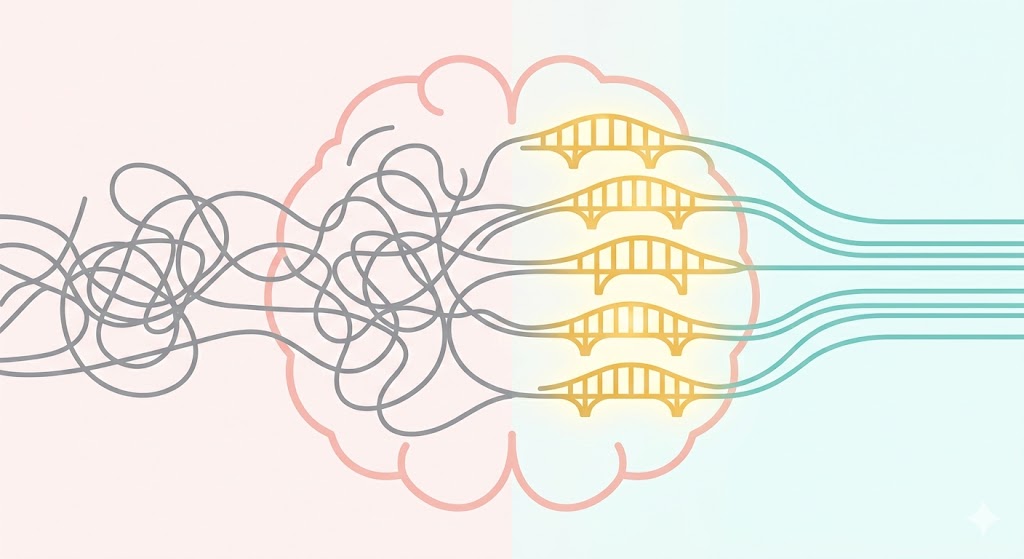
Attachment Theory has become the cornerstone of modern dating psychology, yet for many, discovering their "style" feels more like a diagnosis than a roadmap. If you identify with the Anxious or Avoidant spectrums—patterns often rooted in early childhood neglect or inconsistent caregiving—it is easy to feel doomed to a cycle of self-sabotage.
However, clinical psychology offers a profound concept called "Earned Security." This is the process of moving from an insecure baseline to a secure one through intentional inner work and relational experiences. It proves that our relational blueprints are not set in stone; they are living documents that can be rewritten.
Earned security isn't about erasing your past; it's about building a new, resilient internal structure that is stronger than the trauma that preceded it.
Deconstructing the Fixed Style Myth
An attachment style is effectively a survival strategy. If your cries for attention went unanswered as an infant, your nervous system adopted a defensive posture. The Anxious mind learned to maximize signals (hypervigilance) to ensure proximity, while the Avoidant mind learned to minimize signals (self-reliance) to protect against rejection.
The breakthrough of neuroplasticity is that these neural pathways are "plastic." Because these behaviors were learned as adaptations to an environment, they can be unlearned in a new environment. Transitioning to Earned Security involves recognizing these triggers not as personality flaws, but as outdated software that no longer serves your current reality.

Relational Co-Regulation: The Healing Power of the 'Secure Other'
While self-help books are valuable, the most accelerated path to security is through co-regulation. We are social animals; our nervous systems "tune" to those we spend the most time with. Clinicians argue that you cannot fully heal a relational wound in isolation—it must be healed within a relationship.
The Mismatch Experience
When an anxious person expects abandonment but receives consistency, the brain experiences a "prediction error" that forces it to update its worldview.
Safe Harbor Effect
A secure partner provides a steady emotional baseline, allowing an insecure partner to explore vulnerability without the fear of catastrophic loss.
Over time, the steady, predictable love of a secure partner literally rewires the amygdala—the brain's fear center. When your partner responds with warmth instead of distance, the neural pathways associated with panic begin to prune away, replaced by those associated with trust and safety.
The Discipline of Internal Healing
While a partner can assist, the heavy lifting of Earned Security is an internal job. It requires metacognition—the ability to observe your thoughts without being consumed by them. This means noticing the rising tide of "protest behavior" and making a conscious, often difficult, choice to act differently.

Practicing earned security looks like:
- • Self-Soothed Regulation: Instead of texting 20 times when someone is late, learning to regulate your own heart rate through breathwork or grounding exercises.
- • Non-Violent Communication: Expressing a need (e.g., "I feel lonely") rather than a criticism (e.g., "You never spend time with me").
- • Boundary Setting: For the avoidant, this means leaning into the discomfort of closeness; for the anxious, it means respecting the space of others.
Tired of the Toxic Cycle?
Put this psychology into practice. Match with verified, intentional users on our secure Telegram platform and escape the swipe fatigue.